

Looking Back at the Venice International Watercolor Festival: Reframing the Global Coordinates of Watercolor Through “Art Historical Anchors”
By Zhang Hongbin and Ji Yinglun
Since its inaugural edition in 2023, the Venice International Watercolor Festival (Le Venezie International Watercolor Festival), jointly initiated by the Italian Cultural and Artistic Exchange Association and Sheng Xinyu Art from China, and strongly supported by the Municipality of Treviso, has been successfully held for three consecutive editions. The fourth edition is scheduled for October 2026.
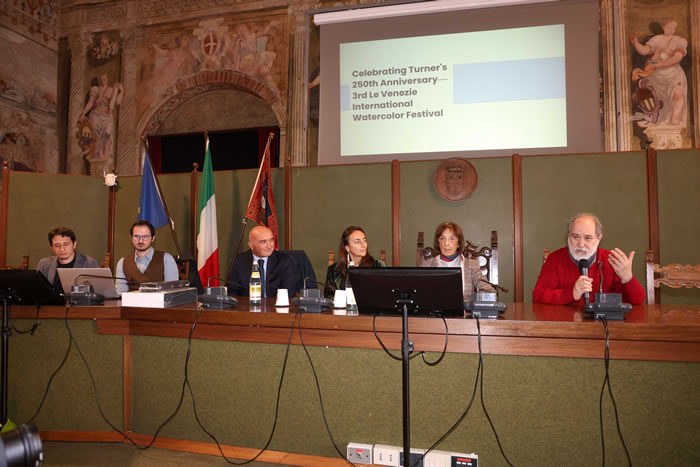
The festival is firmly rooted in the historic city of Treviso in the Veneto region, hosted at the Palazzo dei Trecento. With its clear international positioning, rigorous academic standards, deep connection to the historical and cultural context of Venice and Europe, and its precise alignment with significant milestones in art history across four consecutive editions, the festival has rapidly risen within the global art landscape and become an increasingly important reference point in the international watercolor community.
Philosophy and Core Characteristics of the Festival
The Venice International Watercolor Festival has distinguished itself amid intense competition among international art events largely because, from its inception, it established an ambitious vision that goes far beyond a conventional competition. Using watercolor as a universal artistic language, the festival is committed to building a global watercolor art ecosystem. Guided by the spirit of “celebrating the triumph over the pandemic, praising the beauty of life, and wishing for world peace,” it embodies a strong humanistic concern and social mission. This consciously articulated philosophy enables the festival to transcend the limitations of purely technical exhibitions and competitions, entering deeper cultural discourse.
In curatorial practice, the festival adheres to the principle of “balancing openness with discipline.” Artists are granted maximum creative freedom, with works spanning diverse subjects and styles, including portraiture, landscape, still life, and abstract exploration. At the same time, the festival maintains strict professional standards for the watercolor medium, requiring the dominance of water-based media within each work. This ensures an organic balance between diversity of artistic expression and the purity of the medium.
The judging system forms the cornerstone of the festival’s credibility. The inaugural edition assembled an exceptionally rare “joint jury of five national watercolor society presidents,” including leaders from the National Watercolor Society (USA), the Royal Watercolour Society (UK), the Australian Watercolour Institute, the Spanish Watercolor Society, and the Irish Watercolour Society. By the third edition in 2025, the jury had expanded to 15 internationally recognized experts from seven countries: the UK, Italy, Spain, Ireland, the United States, Belgium, and China. All submissions are evaluated through a two-round anonymous blind review process, in which jurors have no access to the artists’ names or nationalities, focusing solely on technique, aesthetics, originality, and conceptual depth. The final decisions are “conclusive and non-appealable.” These mechanisms have earned widespread international recognition for the academic authority of the awards.
The choice of venue further reflects cultural awareness. The Palazzo dei Trecento, built in the 14th century, preserves Venetian School frescoes dating from the 14th to 16th centuries. Treviso, known as the “Gateway to Venice” and often called “Little Venice” due to its dense network of waterways, provides a natural geographical and symbolic legitimacy for watercolor—an art form intrinsically tied to water.
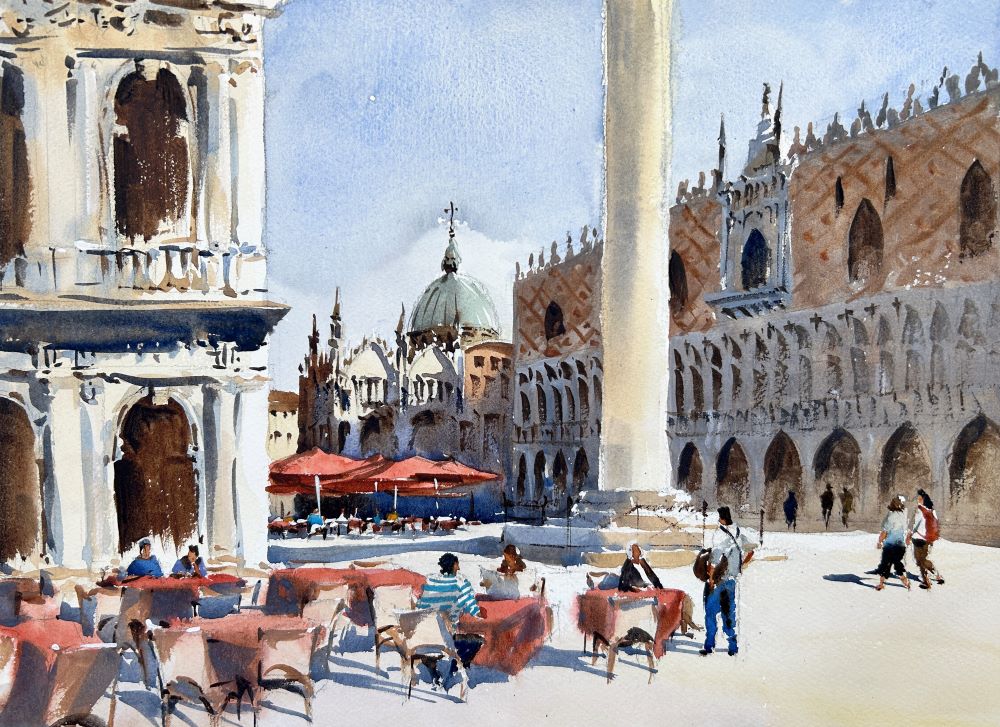
Development of the Venice International Watercolor Festival
The first edition (2023), launched on January 20, was one of the most representative revival projects in the international watercolor field following the pandemic. The competition received more than 1,200 submissions from over 20 countries and regions. Concurrent exhibitions were held in Italy (main venue), the United States (Morehead State University Art Gallery in Kentucky), and Beijing, China. This marked the first time that a major international watercolor competition established a parallel exhibition venue in China, widely regarded as formal recognition of the strength of Chinese watercolor on the global stage.
The second edition (2024) coincided with the 700th anniversary of the death of Marco Polo (1254–1324). The festival was officially incorporated into the City of Venice’s commemorative program, receiving formal recognition by municipal resolution as a model of “East–West artistic dialogue” within city-level celebrations. For the first time, the competition introduced dual categories: an “Open Theme” and a “Marco Polo Theme,” each awarding a first prize of USD 2,000. All exhibited works received a specially designed commemorative medal marking the 700th anniversary. This milestone signified the festival’s transformation from an independent international competition into an official partner within Venice’s cultural agenda.
The third edition (2025) was themed around the 250th anniversary of the birth of the British Romantic master J. M. W. Turner. The organizers expanded into a trilateral collaboration among the Independent Turner Society (UK), the Italian association, and Sheng Xinyu Art from China, forming a stable trans-Eurasian academic alliance. The exhibition was held from October 11 to 26, with the top award, the “William Turner Grand Prize,” carrying a prize of USD 2,000. For the first time, the event also received commercial sponsorship from leading Italian watercolor brands Maimeri and Tintoretto. By anchoring itself for a second consecutive year to a major milestone in art history, the festival formally established its “art historical anchor” exhibition model.
The fourth edition (2026) will return to the Palazzo dei Trecento under the theme “Inheritance and Exploration: Memory and Contemporaneity of Watercolor.” It pays tribute to the Bicknell family of Britain: Elhanan Bicknell, an important 19th-century patron who strongly supported watercolor masters including Turner, and his son Clarence Bicknell, renowned for his botanical watercolor illustrations and known for his multiple identities as an artist, amateur archaeologist, and promoter of Esperanto. Together, they represent a complete ecological chain of watercolor encompassing “patronage—creation—scientific documentation.” This edition celebrates the integration of art, science, and nature, creating a new interface for the festival to evolve from a purely artistic competition into an interdisciplinary cultural event bridging art and science.
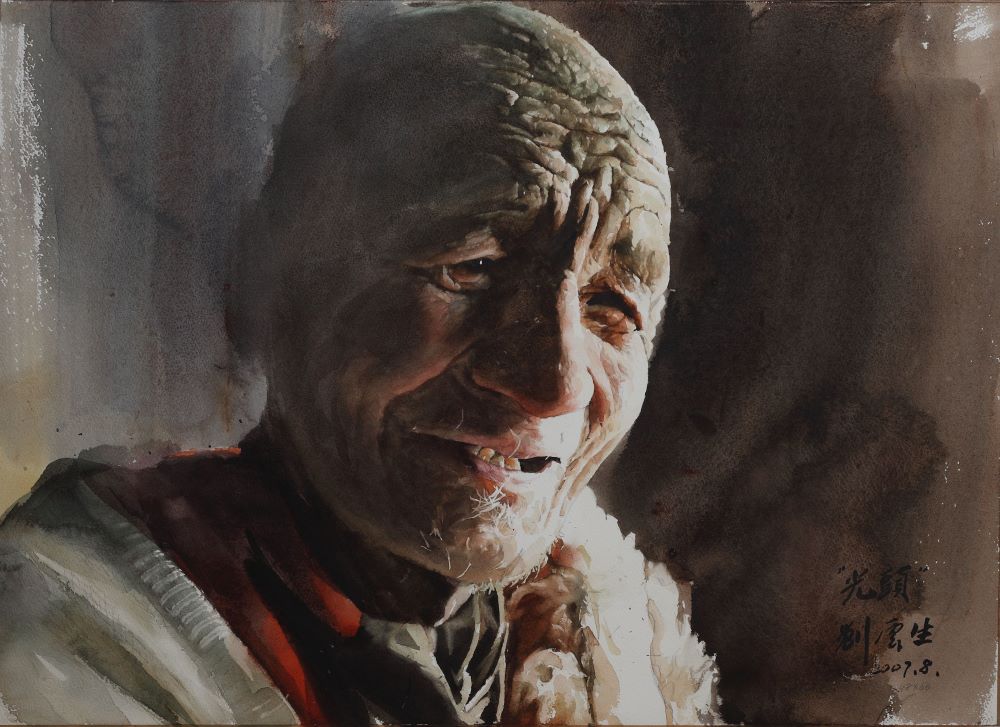
The Triple Value of the “Art Historical Anchor” Model
From Marco Polo to Turner and then to the Bicknell family, the themes of the four editions are not incidental but reflect a consciously constructed curatorial methodology. Its value spans three dimensions: historical, contemporary, and present-day relevance.
Its historical value lies in reinserting watercolor into the central narrative of world art history. Taken together, the four themes form a clear trajectory: “civilizational exchange (Marco Polo) → revolution of light and color (Turner) → integration of art and science (the Bicknell family).” This represents a deliberate “rewriting of watercolor art history,” systematically challenging the long-standing perception of watercolor as a “secondary medium.”
Its practical significance lies in enabling an emerging festival to gain institutional cultural endorsement and the ability to mobilize cross-disciplinary resources. The second edition’s integration into Venice’s official commemorative framework, the third edition’s activation of a trans-Eurasian academic alliance across the UK, Italy, and China, and the fourth edition’s opening toward collaboration between art institutions and the natural sciences together demonstrate how “art historical anchors” function as a replicable and scalable mechanism for resource aggregation.
Its contemporary significance lies in providing watercolor with renewed legitimacy in the 21st century. In an era dominated by digital imagery and AI-generated art, the festival has re-established watercolor’s relevance through four key directions: rebuilding its academic stature, activating its potential for contemporary innovation, expanding its public cultural role—particularly its function as “art witnessing nature” in relation to ecological issues—and constructing a global watercolor community. In doing so, it grants this traditional medium a renewed cultural legitimacy in the present day.
Across four editions, the Venice International Watercolor Festival has achieved a four-stage leap: from a post-pandemic revival initiative, to a city-level cultural event, to a transnational academic brand, and now toward an interdisciplinary platform bridging art and science. From Marco Polo to Turner and then to the Bicknell family, each theme simultaneously reflects on the past and points toward the future: Marco Polo positions watercolor as a messenger of civilizational dialogue; Turner establishes its role as a precursor to modern art; and the Bicknell family directs it toward a future at the intersection of art and science.
As the 2026 edition returns once again to the Palazzo dei Trecento, watercolor—once underestimated as a traditional medium—is re-entering the central narrative of world art with unprecedented academic self-awareness and cultural visibility. This may well be the festival’s most profound contemporary significance: it is not only revitalizing an artistic medium, but also demonstrating a complete pathway for how traditional art can regain cultural legitimacy in the 21st century.